
This section presents selected publications that contribute to the intellectual and methodological foundations of the QuantPhi Program.
These works include foundational texts authored by QuantPhi academic contributors, as well as academic publications that reflect the rigorous mathematical perspective underlying our educational approach.
Foundational Publications
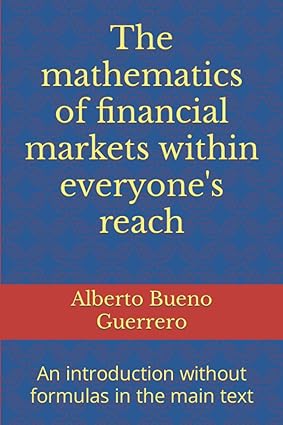
The Mathematics of Financial Markets Within Everyone’s Reach: An Introduction Without Formulas in the Main Text
Alberto Bueno Guerrero – QuantPhi
This volume provides a conceptually rigorous yet accessible introduction to the mathematical structure of financial markets. By presenting key ideas without technical formalism in the main exposition, it offers an intuitive entry point into Quantitative Finance while preserving mathematical coherence.
The book serves as a conceptual bridge to the formal QuantPhi Program in Mathematical Finance (see Our Courses) and is particularly suitable for readers seeking structured intuition before engaging with mathematical models.
Who is this book for?
“For all of the above, the book is aimed at a plurality of readers. In the first place, there would be those with no relation to Finance, but whose intellectual curiosity leads them to wonder what the mathematics that governs the financial markets will be like. For this type of readers, no prerequisite is necessary. The book is written in such a way that it can be understood with only knowledge of basic mathematical operations and simple graphical representations. On the other hand, there will be all those students of any degree related to some field of Economic and Business Sciences, or with others of a technical nature such as Physics, Mathematics or any Engineering, who consider the possibility of doing a postgraduate degree related to Quantitative or Mathematical Finance. In this group I would also include all those who want to obtain any of the certifications related to Quantitative Finance (CQF, FRM, …). For this type of student, this book would be a short and gentle introduction to the mathematical concepts they will need. Finally, another type of reader would be those already dedicated to finance, either from an academic or professional point of view, who intend to fi ll in some gap in their training, or learn about examples, analogies, points of view and anecdotes that they will not find in the more formal literature.” (Excerpt from the preface of the book)
Available in print via Amazon and in digital format (PDF) via Leanpub.
Spanish edition available:
Las Matemáticas de los Mercados Financieros al Alcance de Todos (Amazon | Leanpub).
Table of contents:
QuantPhi Series in Mathematical Finance
The QuantPhi Series in Mathematical Finance is conceived as a collection of mathematically rigorous volumes devoted to the analytical foundations of modern Quantitative Finance.
Each volume addresses a specific domain within Mathematical Finance and is written in a formal definition–theorem–proof style. The series is intended for postgraduate-level study and provides a coherent theoretical framework aligned with the QuantPhi educational programs.
The books are aligned with the corresponding courses of the QuantPhi Program in Mathematical Finance (see Our Courses), while remaining pedagogically independent.
Volume I: Introduction to Stochastic Calculus
Alberto Bueno Guerrero – QuantPhi
Introduction to Stochastic Calculus develops the theory of stochastic calculus for Itô processes in a rigorous, systematic, and self-contained manner, placing particular emphasis on mathematical intuition, careful motivation, and complete proofs. Throughout the text, mathematical concepts are illustrated through examples and reinforced by numerous exercises and problems with complete solutions.
Two appendices reviewing measure theory, integration, functional analysis, and probability theory provide the mathematical background required for a self-contained reading of the text.
Written for graduate students and practitioners with a background in calculus and probability, this volume provides the theoretical foundation required for the study of modern mathematical finance.
Who is this book for?
“This book is conceived as the first volume in a collection dedicated to mathematical modeling in finance. Therefore, a natural readership would include university students or graduates with STEM degrees, such as physicists, mathematicians, engineers,
economists and statisticians, who wish to pursue a career in quantitative finance or simply explore this fascinating field.
Furthermore, since the quantitative finance models themselves are deliberately postponed to subsequent volumes, this book contains virtually no financial applications of the mathematical tools it develops, apart from a few isolated references. For all
these reasons, the book will be of interest to readers with a mathematical background who, while not initially interested in mathematical finance, wish to study a branch of mathematics that they are unlikely to have encountered during their undergraduate
studies.
The book may also serve as recommended reading for postgraduate courses in stochastic calculus. As I mentioned earlier, quantitative analysts and researchers in quantitative finance will find this book a useful reference text, both for refreshing forgotten concepts and for acquiring new knowledge that was not covered during their formal education.
Finally, anyone who, even if unfamiliar with the financial world, is curious and in need of intellectual stimulation, may find in this book an engaging intellectual challenge that could lead them to the exciting world of quantitative finance.
I hope that, whether you identify with any of the groups described above or not, you will enjoy reading and studying this book and find the experience truly rewarding.” (Excerpt from the preface of the book)
Available in print via Amazon
Table of contents:
Further books will be announced progressively.
Academic Publications
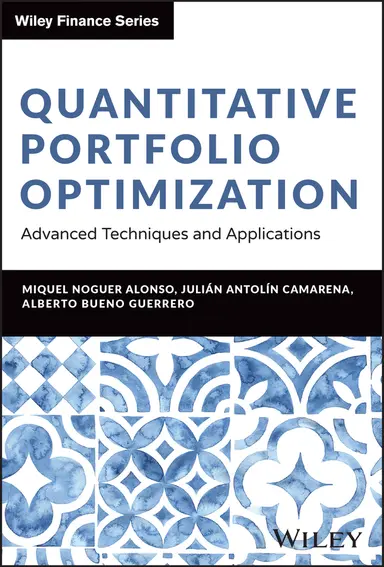
Quantitative Portfolio Optimization: Advanced Techniques and Applications
Miquel Noguer Alonso, Julián Antolín Camarena, Alberto Bueno Guerrero— Wiley
This work presents a rigorous treatment of Quantitative Portfolio Optimization within a mathematical and computational framework.
It covers mean–variance optimization, the Black–Litterman model, risk parity, factor-based allocation, robust optimization, and selected machine learning techniques for asset allocation.
The book reflects the analytical foundations that inform the QuantPhi approach to Quantitative Finance.
Available via Wiley and Amazon.
To receive updates regarding upcoming releases, please subscribe to the QuantPhi Newsletter.